
The next ‘Pin’ I recreated is a “Bingo Colors” game. The purpose of the game is to help children learn their colors in a fun, interactive way. To begin, you must create the bingo cards. Divide each card into nine squares and color them all different colors and variations.
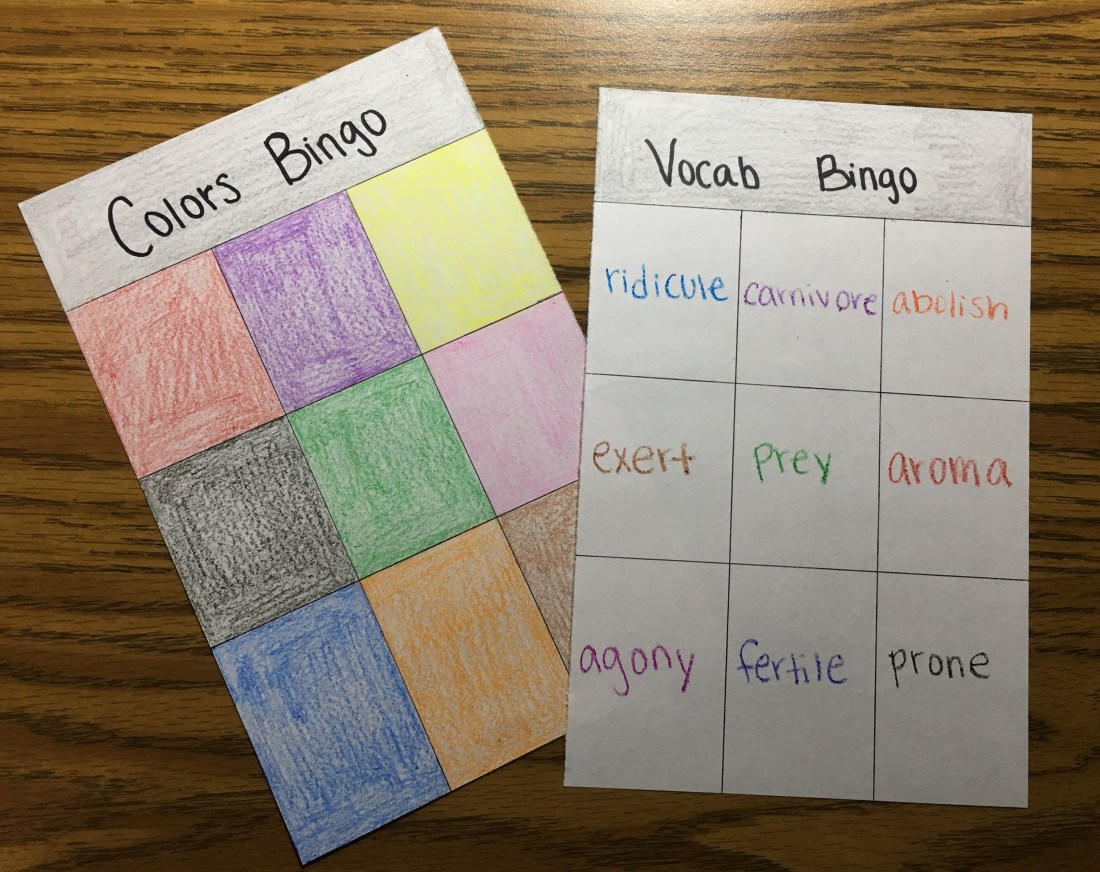
To play the game, instead of calling out “B 12”, you will call out a color. For instance, if you call out “Pink”, each student who has a pink square on their board should cover it with a token. The idea, though, is that they have to know what the color looks like when you call it out to know where to put the token. I would suggest this game is targeted for preschool aged children as its concept is very basic.
There are ways you may adapt it for older aged children. For example, I also made a “Vocabulary Bingo” game. Instead of filling the boxes with colors, I wrote different vocabulary words. In this case, you would read out a definition, such as “A distinctive, usually pleasant smell”, and the student would put their token on the word “Aroma”. In this variation, the student must know the definition of all the words on their card to be able to match the given definition to a word. You could also use this game idea for many different subjects in school. For mathematics, you could make a “Multiplication Bingo” where the answers to multiplication equations you read aloud are written in the boxes. For science, you could create a “Periodic Table of the Elements Bingo” where you read out the name of an element and their symbol is written in the boxes on the card. You could also modify the game for history, grammar, or foreign languages.
Overall, I think the game could be useful in a classroom setting to fill time. It is beneficial because it targets auditory and visual learners, but it may not be good to implement as a main source of instruction. The game could be finished quickly because there are not many boxes and students may get bored. You will need to gauge whether or not you think your students are gaining anything from the activity if you choose to implement it often.

 Allison's EDIT 2000 Adventure